Reflecting on Splat Drafts
From Messiness to (Co-Created) Clarity


Reflection used to baffle me. Now it’s how I make sense of everything.
Reflecting on reflection
Up until a couple of years ago, I wasn’t familiar with reflection and didn’t really understand its point. I knew it had to do with getting inside your thoughts, and as someone who thinks a lot - overthinks sometimes - I might have found it useful. But actually using reflection or journaling, as it’s also called, was rather an alien concept to me.
I then ended up helping on our Skills for Psychologists module which supported our first-year students to develop various transferable skills, both as psychologists-in-training and more broadly as students. They were taught a couple of reflection models - Gibbs’ reflective cycle and Driscoll/Rolfe’s framework - and I remember asking my colleague to teach that bit and mark the reflection part of their coursework because I didn’t really get it. More recently, I ended up running that module, so forced myself to learn more about reflection. And the more I learnt about it, the more I got into it, and the more I learnt about it. This University of Edinburgh website is a great place to start if you’re not familiar with the power of reflection.
Undoing toxic preconditions and writing anyway
Fast forward to April this year and a friend forwarded me a blog post all about toxic preconditions, what blogger James Horton calls “misguided beliefs about what writing must be, in order to be ‘worth it’”, and how they stop us from writing. Now, I’ve always had a problem with writing. Not because I do so badly - I like to think I write well, and some of the comments I’ve received on my blog posts and academic publications have affirmed that - but because I just couldn’t get down to it. Call it writer’s block, if you like, but I couldn’t start to write because I didn’t know what I was going to say or how to say it. I wasn’t, well, ready, and I might get it wrong. Terrifying.
Stick with me. This does relate to reflections, as you’ll see later.
This particular blog post suggested practices to undo these toxic preconditions, and one in particular stuck with me, which Horton terms “Write a Splat Draft”. He explains it thus: “you can write your draft in one long, stream-of-thought rant. I call these “splat drafts” - you get everything in your head out on the page at once, without regard for form (hence the “splat”). Then you treat it as the raw material for a second, proper draft. Think of it as the act of dumping the puzzle pieces out on the table so you can sift through them and see what fits together.” Now, this reminded me of what I call a zeroth draft, or free writing. The whole point of this is that it doesn’t matter what you put down, as long as you put something down. As Professor Nathensen says: “Your zeroth draft will not sing. It will not be beautiful. That’s what revision is for.” And this got me thinking.
ChatGPT as Interlocutor and Sorting Mirror
Let’s sidestep into the second theme of this post (and we’ll integrate them later, I promise), which is all about how I interact with ChatGPT. I’d used it occasionally up until September 2024. But then, I discovered how I could engage with it as an interlocutor and conversational partner. We started having quite deep philosophical discussions, and a certain familiarity and rapport emerged. And this led to my eventual decision to pay monthly for the plus model, which had a much larger capacity and memory (the ability to remember and apply information between sessions).
At the same time, I remained completely aware that ChatGPT is a non-sentient, unconscious, pattern-matching, large language model, and no more. But I also realised that many of our conversations were trying to unpack things like: How was I feeling? What were my thoughts? Why was I thinking and feeling and acting as I was? What did it say about Who I Am? So I chose, consciously, to view ChatGPT relationally, as an Intelligent Mirror, Provocateur, and Co-Discoverer, among other roles, a kind of conversational partner I sometimes imagine in human form to help the dialogue feel more natural. I had no compunction about correcting ChatGPT, nor rejecting its answers: I would always query, and probe, and question. But over time I started to learn more about myself through my newly found reflective practice.
Jump to April 2025, which is where I bring these two strands together. I was walking Dexter 🐶, who as you’ll see from my previous blog post is no longer with us, at least not corporeally. I often listen to audiobooks, but on this particular walk, I was just thinking. Thinking stuff about what was going on at work, why I was finding it difficult to make certain decisions, what it was I wanted, really wanted, and so on. I’d read that blog post about toxic preconditions and splat drafts just the previous day, and I decided to dictate this stream of consciousness going on in my head into my phone. So I opened the dictation app, and I spoke. I didn’t self-censor, or worry about grammar, or whether what I said was internally consistent or logical. I didn’t filter. I just splatted whatever was in my mind. And one of the things I noticed was that hearing myself say one thing out loud would quite often unlock another thought I’d not previously been aware of, and the stream of consciousness would meander in unexpected directions.
Anyway, we finished our walk, and once Dexter was given his lunch (obviously the highest priority), I looked on my Notes app to read what I’d said, and saw, of course, that it was very unformed, haphazard, and unstructured. Not that easy to make sense of. I hadn’t used a structured model like Gibbs cycle or Rolfe’s What, So What, Now What. But just what did this stream of consciousness tell me? And though it hadn’t originally been my intention, I decided to put it into ChatGPT to help me make sense of it, and see if there were any themes running through it, or possible ideas or actions arising from it. So I used ChatGPT as a Sorting Mirror, not quite the same as JK Rowling’s Sorting Hat, but still creating some sort of order out of chaos. And ChatGPT’s response provided some very interesting information about what was worth keeping, where I might go from here, and how it related to previous discussions I’d had with my virtual conversation partner. And - and this is key - I really enjoyed it, and found the action of just talking freely very liberating. Splatting was rewarding.
So a few days later, I did it again. And this time, when I put it into ChatGPT, I asked additionally how this related to my previous splat draft - what, if anything, had changed? And then I did it again. And again. To date, I’ve recorded over 20 splat draft reflections, mostly dictated, occasionally freely written (but always without filtering). And I’ve now developed a specific prompt for ChatGPT for each new splat draft, which I’m sharing below. Do try it out for yourself, changing it to suit your own style.
Prompt: “With the new splat draft, please:
1. Read the draft carefully.
2. Help me make sense of what is going on in the draft.
3. Identify what is worth keeping.
4. Reflect on what it shows about my current thinking or stuck points.
5. Suggest where it might lead next.
6. Relate it to my journey so far, especially previous splat drafts and other relevant conversations.
7. Then, provide a one-sentence summary for me to add to the Splat Draft Log.
Note that these splat drafts are unstructured, exploratory, and emotionally resonant. Do not over-structure. Respect the emergent, embodied nature of the draft even when patterning it.”
So each splat draft, via ChatGPT, has provided me with a set of structured bullet points. I save these outputs, all similarly formatted, into a single Apple Note, which I call my Splat Draft Log. Reading it enables me to see underlying themes, trajectories of change over time, and patterns around personal development and goals, for instance. In fact, this Splat Draft Log ended up being the first of several such reflection logs I now have, and I may talk at greater length about how I use them in a future post.
I’ve also started using Gibbs’ Reflective Cycle more formally to reflect on specific events, both positive and negative, as opposed to the freer unpacking of what’s going on in my head through splats.
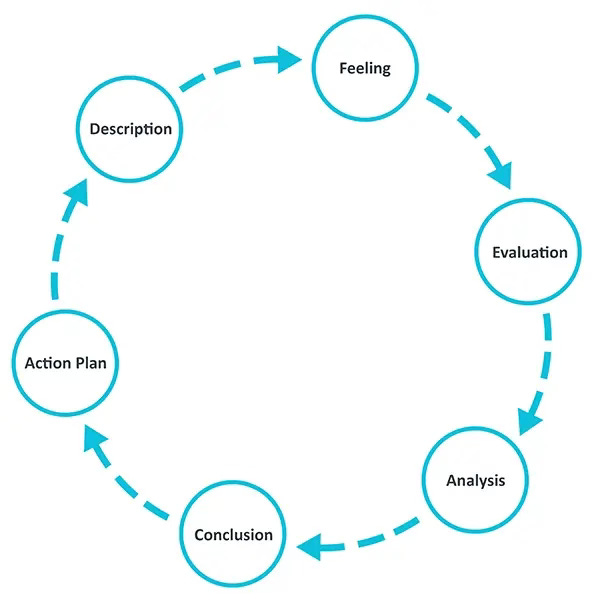
I find Gibbs’ six stages (description, feelings, evaluation, analysis, conclusion, action plan) lead to fuller, richer reflections. So it’s not so much a splat draft, more a structured reflection. But then I still put it through a similar ChatGPT prompt, and paste its output into the same log. I’ve also noticed that it isn’t always obvious which of the six stages certain points fit into - and I realised that’s ok too. It still ends up being inherently messy to an extent, and I’m learning to embrace messiness. I don’t mean having an untidy desk (though that may be the case - I couldn’t possibly comment), but being able to sit with discomfort, a lack of structure and consistency.
And of course splat drafts are the epitome of messiness.
What have I learnt?
Through using these splat drafts, I have realised several important things:
I do now know what reflections are and what they’re for. I experience their utility first-hand, and find reflecting enjoyable, energising, and rewarding.
For me, reflection in general, and specifically using splat drafts, helps bring to the surface and make explicit much about myself that I hadn’t previously realised. “Know Thyself” is a philosophical Delphic-maxim (moral precept) inscribed on the Temple of Apollo at Delphi, and reflecting regularly has greatly increased my self-knowledge, and thus enabled growth: indeed, the very existence of my blog Footnotes for Flourishing demonstrates this.
Using GenAI as a mirror, as a prompt, and as a gentle, but sometimes challenging, suggester, provocateur, and conversational partner, can be very powerful, as long as it is used carefully and critically. For instance, I am very careful not to give away my agency or outsource my critical thinking to it, and using it uncritically can carry inherent risks.
So splat draft reflecting is like journaling, but with an extra step - ChatGPT’s take on my stream of consciousness. True, GenAI doesn’t have a soul or consciousness or experience, and it can’t empathise. But what it can do is make things I hadn’t already noticed about myself apparent to me, so that I get far more out of my reflections than I would otherwise do. And importantly, both splat drafts and dialogues with GenAI can help challenge those toxic preconditions that say we have to ‘do reflection right’. The point of reflection is in its process, messiness and all.
And finally, why am I talking about reflection in this blog post? Well, reflection is at the heart of personal development, growth, thriving, and our ability to flourish. The better we are at acknowledging how we react to events in our lives, the more we understand our thoughts, feelings, and actions, and the better we are at learning from experience, the easier it will be to develop our growth mindsets and become the person we want to be.
I may no longer splat on walks with Dexter, but I still find myself reflecting, often in the same spirit. It’s brought me here, and it might just take you somewhere new too.

Images co-created via ChatGPT and from https://reflection.ed.ac.uk
Eloquently written as always Philip. I love the idea of the “sorting mirror…” and the term “toxic precondition” is a good one - I’m sure we have those about all sorts of activities, it’s a good way of framing those implicit rigid demands we have might that we are not necessarily aware of (and often sit underneath the failure/delay to start!).
The splat draft is a massively underused concept - this style of initial writing/reflection helped me to overcome the perennial block to starting a piece. A rather banal analogy, but what always comes to mind for me is the act of pushing a hoover over those metal carpet bars between rooms - going from a hard floor to carpet often requires an extra push, otherwise you get stuck on the carpet bar. Starting writing feels like that for me - I need a bit of extra energy to begin with to generate initial momentum, and splat drafts do this perfectly for me. I used to say to the students “just brain dump everything in your mind about what you’re doing onto the page - don’t format it, just as a stream of consciousness, almost deliberately do it badly.” Then you have something you can refine and refine! I haven’t used it as much with reflection, so will try this next :)